CIO Corner: From Automation to Agentic Orchestration

Healthcare providers continue to face tightening reimbursement, burdensome denial management, increasing patient financial responsibility, and other pressing operational and financial challenges. In this environment, simply adding more people or more point solutions are no longer enough. XiFin believes the future belongs to organizations that can combine trusted data, intelligent automation, and governed AI to create entirely new operating models.
AI Is Everywhere. Advantage Is Not.
Artificial intelligence has rapidly become ubiquitous across the healthcare and technology sectors. Virtually every technology vendor now claims AI-powered capabilities, making AI itself a poor differentiator. The real advantage comes from systems that leaders can trust, govern, and measure—systems that drive accountability and operational results.
Healthcare organizations typically operate in highly complex administrative environments, fragmented technology ecosystems, and massive volumes of unstructured data, and AI deployed in these types of environments often amplifies existing challenges rather than solving them.
The Foundation: Data You Can Trust
Before AI can create value, it must operate on reliable data. In revenue cycle management (RCM), this means transaction-level truth, connecting CPT® codes, payor plans, claims, adjudication outcomes, financial transactions, and reconciliation data across the entire revenue lifecycle.1 This architecture preserves financial integrity, context, lineage, and auditability.
AI does not fix data problems; it magnifies them. Organizations that invest in clean, complete, and referentially intact data create the conditions for AI to become precise, reliable, and scalable.
Moving Beyond Automation
XiFin views AI as an evolution of intelligence, not a replacement for existing automation.
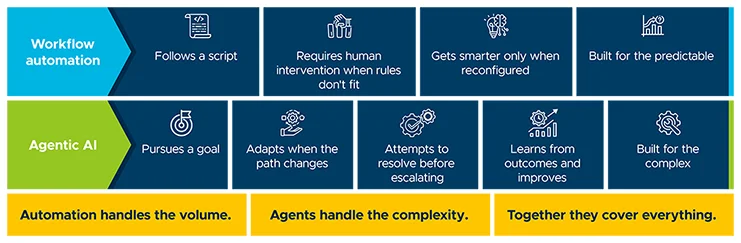
Traditional deterministic workflows (i.e., using automation that follows predefined rules) remain essential in effective RCM. Rules-based engines are useful for routine, predictable scenarios. In fact, XiFin estimates that roughly 70% of revenue cycle work can continue to be handled efficiently through deterministic automation.
The opportunity lies in the remaining 30%, the long tail of denials, exceptions, missing information, and payor complexity that consumes a disproportionate share of staff time. These cases require judgment, investigation, and reasoning. This is where agentic AI is exceptionally well-suited to create value.
What Makes an Agent Different?
Unlike chatbots, AI agents are goal-oriented systems that can reason, act, and self-correct.
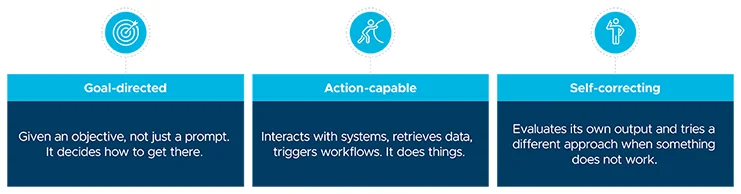
Rather than simply responding to a prompt, agents are given an objective. They determine how to accomplish the task, use tools to gather information, interact with systems, evaluate progress, and adjust their approach until the objective is achieved—or a human decision is needed.
This distinction is critical because many revenue cycle challenges require more than information retrieval. They require investigation, validation, documentation review, policy research, and coordinated action across multiple systems.
From Single Agents to Agentic Orchestration
XiFin’s vision for AI-powered RCM extends beyond individual agents to agentic orchestration, where multiple specialized agents collaborate under the direction of an orchestrator.
Each agent focuses on a specific domain—such as eligibility verification, coding, data extraction, payor policy research, validation, or denial management—while the orchestrator coordinates activities and adapts the workflow as conditions change.
This approach delivers several advantages:
- Specialized expertise for complex revenue cycle functions
- Parallel processing of tasks
- Full auditability of decisions and actions
- Adaptive workflows that respond to changing conditions
- Faster innovation through reusable agent components
XiFin’s growing catalog of agents creates a compounding effect: each new capability accelerates the development of future solutions.
AI Agents in Production Today
For XiFin, agentic AI is not a future concept—it is already operational. The XiFin® Empower AI Appeals Agent is in production, helping automate several aspects of the appeals process. It evaluates denial information, gathers supporting documentation, researches applicable payor policies, crafts patient- and payor-specific appeals packages, and routes exceptions for human review when appropriate.
This reflects XiFin’s broader AI philosophy: start by applying it to a workflow that we can see will deliver clear ROI, prove value in production, and expand based on evidence.
Governance Is a Key AI Feature
In healthcare, trust is non-negotiable. That’s why XiFin has designed its AI architecture with governance, security, and human oversight at the core. Rather than relying solely on policies, XiFin is building structural controls into the infrastructure itself. For example, XiFin solutions limit access by function, implement least-privilege principles, maintain audit trails, and keep sensitive patient information within controlled environments.
Human-in-the-loop controls remain an essential part of the design, ensuring that low-confidence decisions or policy-sensitive actions can be reviewed and approved before execution.
The Leadership Imperative
The organizations that succeed with AI will not be the ones that deploy the most tools. They will be the ones that build the strongest foundations.
Success requires three things:
- Clean, trusted, unified data
- AI-ready architecture with governance and security
- Operating models designed to place intelligence where it creates the greatest value
Sustainable advantage comes from intentionally designing systems that bring people and intelligence together to reduce friction, accelerate revenue, and improve operational performance.
For XiFin, the future of revenue cycle management lies neither in automation nor in AI alone. It is a carefully governed transition from workflow automation to agentic orchestration—where intelligent systems help healthcare organizations absorb complexity, accelerate decisions, and unlock new levels of operational excellence.
Put AI to Work in Your Revenue Cycle
Discover how XiFin Empower AI combines trusted healthcare data, intelligent automation, specialized AI agents, and built-in governance to help organizations reduce administrative complexity and improve financial performance.