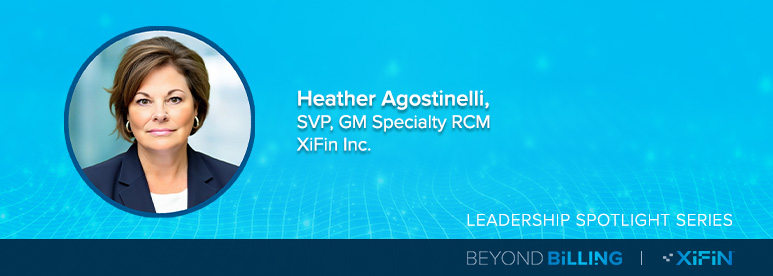
Heather Agostinelli on Leading Specialty RCM With Purpose and Practical AI

XiFin’s senior vice president and general manager of specialty revenue cycle management explains why specialty expertise, trusted partnerships, and a disciplined approach to AI matter for reimbursement performance.
In this update to XiFin’s Leadership Spotlight Series, we feature Heather Agostinelli, senior vice president and general manager of specialty revenue cycle management. Heather has spent decades addressing reimbursement challenges across diagnostics, pathology, radiology, and specialty pharmacy. Her operating principle is straightforward: every claim represents a patient, a provider, and a healthcare encounter that deserves a clear path to reimbursement.
Heather leads XiFin’s specialty RCM business, helping specialty healthcare organizations manage complex payor requirements, reduce preventable friction, and strengthen financial performance. Her promotion recognizes her industry expertise, operational leadership, customer relationships, and ability to move practical innovation from concept into day-to-day revenue cycle work.
Why it matters
Specialty revenue cycle management connects reimbursement operations to patient access, provider capacity, and the financial sustainability of complex healthcare services.
What Is Specialty Revenue Cycle Management?
Specialty revenue cycle management is the set of people, processes, data, and technologies used to secure accurate and timely reimbursement for complex healthcare services. These services often involve specialty-specific coding, medical necessity documentation, prior authorization, changing payor policies, and detailed follow-up across the claim lifecycle.
Electronic health record systems and pharmacy management systems remain essential to clinical and dispensing operations. However, specialty organizations may also need reimbursement workflows, payor intelligence, documentation management, and automation designed for their specific service lines.
“Many specialty providers are leaving significant revenue behind because reimbursement complexity has outpaced the capabilities of traditional systems,” Heather says. “When organizations apply specialty-specific RCM expertise, data, technology, and operational best practices together, the impact can be immediate and substantial.”
For finance and operations leaders, the practical response is to identify where reimbursement breaks down, establish baseline performance, and prioritize the changes most likely to improve outcomes. Relevant measures may include first-pass claim yield, denial rate and mix, time to resolution, manual touches, days sales outstanding, net collection rate, and cost to collect.
Solving a Persistent Specialty Reimbursement Challenge
Specialty service lines can expose gaps that general-purpose billing processes were not designed to manage. Molecular and genetic testing may require extensive medical necessity support and prior authorization. Pathology and radiology organizations must manage specialty coding, documentation, payor rules, and high claim volumes. Specialty pharmacies may need to coordinate pharmacy-benefit and medical-benefit billing, prior authorization, clinical documentation, and patient responsibility workflows.
A purpose-built specialty RCM approach can help organizations prevent avoidable errors, prioritize high-value work, interpret payor responses, assemble documentation, manage denials and appeals, and improve visibility into reimbursement performance. Results vary by organization and should be measured against an established baseline.
Under Heather’s leadership, XiFin’s approach combines specialty expertise, data, workflow automation, and applied AI to help customers reduce administrative burden and improve the consistency of reimbursement operations.
A Career Defined by Purpose
Heather’s professional mission is to help ensure that tests, procedures, and treatments capable of changing a patient’s life have the reimbursement support needed to remain available. Customer visits make that mission tangible.
“When I visited a laboratory specializing in pediatric genetic diagnostics, I was reminded that each specimen represented a child waiting for answers and a family searching for hope,” Heather says. “Behind every claim is a patient story. Helping providers secure reimbursement supports their ability to continue delivering those critical services.”
For Heather, RCM is not simply about processing claims. It supports access to care, healthcare innovation, and the ability of provider organizations to sustain their mission.
Leading Through Relationships and Trust
Ask Heather what she values most about her role, and the answer is consistent: the people. She works with executive teams on strategic priorities and with revenue cycle leaders on operational challenges. Her leadership style starts with listening, understanding the operating environment, and defining outcomes that matter to the customer.
Heather brings the perspective of someone who has managed specialty reimbursement challenges directly. She understands the disruption caused by changing payor policies, more complex prior authorization requirements, and claims that stall despite medically necessary care.
“Healthcare reimbursement is incredibly complex, especially in specialty services,” Heather says. “The best partnerships start with understanding what our customers are experiencing, where they are struggling, and how we can help them achieve meaningful outcomes.”
That consultative approach positions XiFin as more than a software or billing-services provider. It creates a foundation for long-term operating partnerships grounded in transparency, accountability, and measurable improvement.
Applying AI Where It Creates Measurable Value
Heather is particularly focused on helping customers identify the next best opportunities for AI adoption. The objective is not to apply AI to every task. It is to match the technology to the operating problem.
Traditional automation remains effective for consistent, rules-based work. AI can add value when teams need to interpret unstructured information, recognize patterns, evaluate context, or prioritize actions. Human expertise remains essential for consequential, ambiguous, financial, clinical, and strategic decisions.
“Not every problem requires AI,” Heather says. “One of the most important things we can do is help customers understand where AI can improve outcomes and where proven automation already works exceptionally well. That balance helps organizations maximize value without introducing unnecessary complexity or cost.”
XiFin Empower AI reflects this practical approach by coordinating AI, automation, and workflow across revenue cycle functions. Potential use cases include insurance validation, document handling, payor response interpretation, exception prioritization, denial management, appeals preparation, patient responsibility estimation, and reimbursement forecasting.
Executive takeaway
Start with the operating constraint. Define the baseline, expected outcome, governance requirements, and role of human review before selecting AI or automation.
From Psychology to Revenue Cycle Leadership
Heather grew up in Annapolis, Maryland, sailing on the Chesapeake Bay before attending the University of South Carolina. Early in her career, she chose healthcare operations and reimbursement, where her curiosity, problem-solving skills, and people-first leadership style became defining strengths.
After 16 years in pathology revenue cycle management, Heather became one of the founding leaders of McKesson’s laboratory RCM division. During eight years with that organization, she helped advance and scale revenue cycle operations for large laboratory organizations.
XiFin recruited Heather in 2019 to lead strategic revenue operations initiatives. Working with diagnostic customers, she helped strengthen reimbursement performance and operating efficiency while expanding XiFin’s specialty RCM capabilities.
Today, Heather leads XiFin’s specialty RCM business across laboratories, molecular diagnostics, pathology, radiology, and specialty pharmacy. Her mandate is to help customers turn reimbursement complexity into a more manageable, measurable, and strategically important operating discipline.
The Bottom Line
Specialty RCM performance depends on more than technology. It requires specialty knowledge, trusted data, disciplined operations, and relationships built around shared outcomes. Heather’s leadership brings those elements together while keeping the patient and provider impact visible.
As senior vice president and general manager of specialty revenue cycle management, Heather continues to advance XiFin’s mission to help healthcare organizations strengthen financial performance, reduce administrative burden, and sustain access to critical services. Please join us in congratulating her on her promotion.