
Where AI Is Creating Real Value in Revenue Cycle: Featuring Results Achieved by Ambry Genetics

Revenue cycle operations are at a tipping point.
As discussed in a recent Becker’s Healthcare webinar, one of the central challenges facing healthcare organizations today is a growing mismatch between operational complexity and the ability of human teams to scale alongside it. Payor rules continue to evolve, denial patterns are becoming more challenging to stay on top of, and documentation requirements are increasing steadily.
In this environment, traditional approaches, such as expanding staff, improving training programs, incrementally refining processes, or adding point solutions, are showing diminishing returns. As a result, organizations are exploring artificial intelligence (AI) as a broader operating model for revenue cycle management (RCM). During the webinar, Brittany Rambino, Vice President of Revenue Cycle Management at Ambry Genetics, shared how Ambry has approached this shift and described the outcomes observed to date.
The Breaking Point: Complexity Has Outpaced Scaling Labor
A recurring theme of the discussion is that revenue cycle complexity is increasing faster than manual workflows can handle. Teams are managing:
- Large volumes of inbound, unstructured documents
- Frequently changing payor rules and policies
- Increasing denial rates, in some cases influenced by payor-side automation
- Manual triage and routing decisions at multiple stages of the process

As Brittany explained, challenges often arise before work even begins: “Revenue cycle workflows are constrained by the sheer volume, fragmentation, and unstructured nature of inbound documents.”
Manual processes can contribute to backlogs, delays in reimbursement, and workforce strain. Expanding staffing only offers incremental improvements over time.
A New Model: AI at the Edge of RCM
Rather than focusing on optimizing isolated steps, organizations are applying AI across broader workflow stages. Introducing structure and AI earlier in the RCM process can provide additional benefits by improving downstream efficiency.
Examples of application areas include:
- Upstream: document intake, insurance capture, patient estimation
- Mid-cycle: work prioritization, routing, exception handling
- Downstream: denial interpretation, appeals generation
In this context, AI can function not only as a task-specific tool but as part of a system that:
- Interprets ambiguous or unstructured inputs
- Prioritizes work dynamically
- Routes tasks based on predicted outcomes
- Adapts over time through learning mechanisms
This broader approach is reflected in Ambry Genetics’ adoption of AI.
Ambry Genetics: Observed Operational Outcomes
Ambry’s experience provides a set of measured examples of how AI can be applied within the RCM process. These results are based on operational pilots and ongoing usage across multiple areas.
1. Document Intake Automation
One of Ambry’s AI applications focuses on document intake, a common bottleneck caused by fragmented, manual processes. In a five-week pilot, AI was used to:
- Process 320 lockboxes
- Ingest more than 25,000 pages
Results:
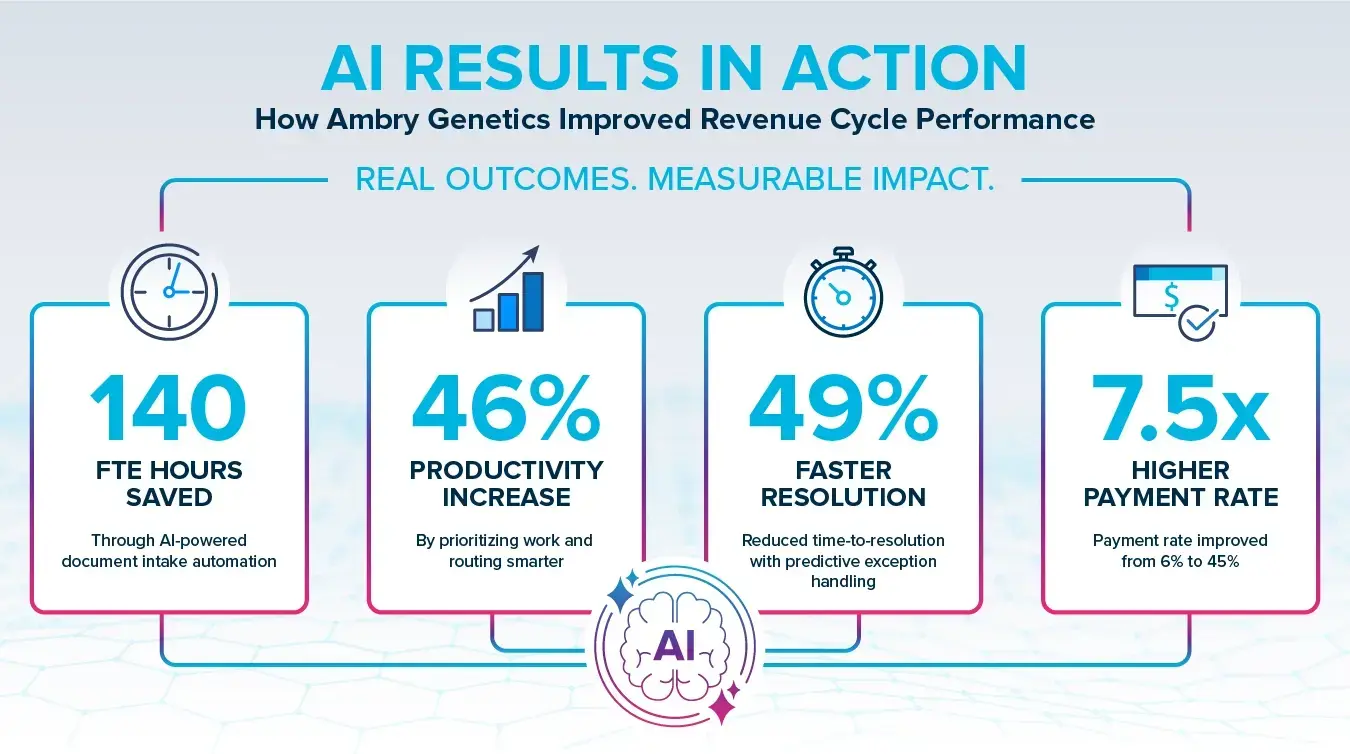
- 140 full-time equivalent (FTE) hours saved
- Reduced overtime requirements
- Ability to manage increased volume without adding staff
As Brittany noted: “As the system continues to learn, we’re saving more and more FTE hours.”
Why this is significant: Document intake occurs at the start of the revenue cycle, and improvements at this stage can influence accuracy and efficiency across later steps. Structuring data earlier can reduce rework and improve downstream throughput.
2. Predictive Exception Handling
Another area of focus was exception handling, where manual spreadsheet routing and the creation of work queues often contribute to inefficiencies. AI was applied to:
- Predict payment likelihood
- Prioritize claims based on value and urgency
- Route denials to staff members with higher historical success rates
Results:
- 46% increase in productivity
- 49% reduction in time-to-resolution
As Brittany observed: “Those are the best numbers we’ve had throughout the years I’ve been at Ambry.”
Why this is significant: This approach reflects a shift toward allocating tasks based on expertise and expected outcomes, including the likelihood of reimbursement, highlighting how AI can support decision-making and automation.
3. Payor Response Interpretation
Payor responses often contain ambiguous or inconsistent language, which can complicate follow-up actions. AI can improve clarity. Ambry uses AI to:
- Interpret unstructured payor responses
- Assign more specific and actionable codes
- Trigger appropriate workflows automatically
Financial impact: Payment rate increased from 6% to 45% for claims that were previously assigned generic codes.
As Brittany explained: “Assigning the appropriate code versus a generic code has been increasing revenue.”
Why this is significant: This example illustrates how improved interpretation of unstructured data can affect downstream outcomes, including reimbursement performance.
4. AI-Generated Appeals
Appeals processes are typically resource-intensive and often rely on specialized staff. AI can expand capacity without adding people. Ambry introduced AI capabilities designed to:
- Interpret clinical documentation
- Generate medical necessity appeal letters
According to Brittany: “The XiFin® Empower AI Appeals Agent writes the letters exactly the way our genetic counselors would write them.”
While still in the early stage of adoption, we started applying the XiFin Empower AI Appeals Agent to only three different denial codes.
Results:
- Turned $852k of potential write-offs into recovered revenue within 8 weeks
- Captured an average price per accession of $3261
- Capacity to overturn many more denials with our existing team of experts
Our team is now better able to keep up with changing payor policies and payor behavior. Going forward, as we increase our denial overturn rate, our market access and payor relations teams will have the evidence they need to re-engage payors regarding our contracts.
Beyond the Metrics: Operational Implications
Beyond individual performance metrics, these examples suggest broader changes in how the revenue cycle can be structured. In Ambry’s case, AI has contributed to:
- Reduced backlog
- Improved process throughput
- Redistribution of staff effort toward higher-value tasks
- A transition toward more proactive workflow management
As described during the webinar, the focus shifts from managing high volumes of administrative work to improving the speed and consistency of reimbursement processes.
Considerations for Revenue Cycle Leaders
Several themes emerged that may be relevant for organizations evaluating similar approaches:
1. Identify High-Friction Areas
Common entry points include:
- Document intake and management
- Denial routing
- Exception handling
- Payor response interpretation
- Appeals management
These workflows tend to involve high variability and significant manual effort.
2. Emphasize Interpretation and Prioritization
Potential gains come not only from automating tasks, but from improving:
- Decision-making quality
- Work prioritization
- Data interpretation
3. Evaluate End-to-End Workflow Integration
Isolated point solutions may introduce fragmentation. Greater impact is often associated with approaches that consider the full workflow.
4. Recognize Organizational Implications
Adopting AI in RCM may involve more than technology implementation, including:
- Workflow redesign
- Changes in team responsibilities
- Alignment across leadership and operations
The Bottom Line
AI is being applied to revenue cycle management in ways that are already showing measurable operational outcomes. Ambry Genetics’ experience demonstrates how these applications can affect productivity, speed, and financial performance. Their results indicate potential for:
- Increased productivity
- Reduced resolution times
- Improved reimbursement performance
- Scalability without proportional increases in staffing
Overall, these developments suggest a shift in how revenue cycle operations may continue to evolve, with greater emphasis on orchestrated, data-driven processes.
Watch the full webinar.