
MRD Testing Is Advancing Fast, but Market Access Strategy Must Move Faster

Minimal residual disease testing is moving quickly from clinical promise to commercial reality, and MRD reimbursement strategy needs to keep pace. According to estimates from the Laboratory Economics June 2026 publication, the U.S. clinical market for tissue- and blood-based MRD assays is projected to reach approximately 1.9 million tests in 2026, up 44% from 2025, with total lab testing revenue expected to grow to $2.7 billion.

That growth reflects real clinical value. MRD testing can help clinicians detect residual cancer during or after treatment, monitor response, assess relapse risk earlier, and support more personalized treatment decisions.
Clinical adoption is accelerating faster than reimbursement policy development. For many laboratories, the greatest challenge is no longer demonstrating the clinical value of MRD testing, it is navigating increasingly complex coverage policies, coding requirements, utilization management, documentation expectations, and payor-specific reimbursement rules. As testing volumes grow, laboratories that treat reimbursement strategy as a core component of commercialization, not simply a downstream billing function, will be better positioned to scale successfully.
This is the first article in a three-part series on MRD reimbursement:
- Article 1 focuses on market access strategy and reimbursement readiness.
- Article 2 explores the operational capabilities laboratories need to scale MRD reimbursement effectively.
- Article 3 examines how oncology pharmacists can help connect MRD-driven clinical decision-making to documentation, access, and reimbursement readiness.
Repeat Testing Changes the MRD Reimbursement Equation
Unlike many molecular diagnostics, which are performed once to establish a diagnosis, MRD testing is longitudinal. Each subsequent test may be evaluated differently depending on disease status, treatment phase, prior testing history, payor policy, and medical necessity documentation. As a result, reimbursement strategy must account not only for whether the test is covered but also for when it is covered and under what clinical circumstances.
Each test within a sequence may raise new coverage, frequency, authorization, and documentation questions. That means reimbursement readiness must be built into the MRD strategy early across activities such as:
- Coding
- Prior authorization
- Utilization management
- Documentation
- Billing workflows
- Denial prevention
- Policy monitoring
For laboratories, sustainable growth depends on more than the ability to perform a sophisticated assay. It requires reimbursement intelligence, disciplined documentation, cross-functional alignment, and scalable workflows.
Coverage Policy Is Not Keeping Pace with Clinical Adoption
MRD growth is being driven by clinical demand, technology advancement, and the broader shift toward personalized oncology. Flow cytometry, PCR-based methods, ctDNA analysis, and NGS-based approaches are all contributing to the category’s expansion.
Reimbursement standardization, however, has not kept pace. Medicare coverage for MRD testing may be governed by National Coverage Determinations (NCDs), MolDX Local Coverage Determinations (LCDs), or Medicare Administrative Contractor (MAC)-specific billing requirements, while commercial payors frequently develop their own medical policies with different coverage criteria, testing frequency limitations, documentation requirements, and evidence expectations. Coverage is generally more established for certain hematologic malignancies; reimbursement for solid tumor MRD testing, by contrast, often remains more variable as clinical evidence and payor policies continue to evolve.
That variability makes reimbursement strategy a market access issue, not a downstream billing issue. Laboratories need to anticipate coverage requirements before volume scales.
Key Coverage Variables Laboratories Must Anticipate
- Restrictions on test methodology – Some payors may limit coverage to specific MRD methodologies, such as flow cytometry, while excluding certain NGS-based assays.
- Frequency and timing of testing – Coverage may limit testing frequency based on treatment phase, monitoring intervals, or disease status.
- Coverage for relapse versus remission monitoring – Coverage criteria may differ between remission monitoring, relapse detection, and initial treatment assessment.
- Payors may apply different standards for clinical utility, guideline alignment, and medical necessity.
- Laboratory-specific coverage variability – Coverage policies and reimbursement may vary by laboratory, assay, or contracted provider status.
- Lack of uniform documentation requirements – Documentation expectations often vary across payors, creating inconsistent denial and appeal outcomes.
Coding and Z Codes Shape MRD Market Access
As MRD volumes grow, payors will continue to look for clearer ways to identify, evaluate, and adjudicate these assays. Coding strategy, Z Code requirements, clinical evidence, and documentation alignment should be considered early in launch planning.
One important strategic decision is whether to bill an emerging MRD assay using an unlisted molecular pathology code (CPT 81479) or pursue a Proprietary Laboratory Analyses (PLA) code. While CPT 81479 offers flexibility for new and evolving assays, unlisted codes often receive greater scrutiny because they do not uniquely identify the specific test being performed. This can increase requests for medical records, manual claim review, and variability in reimbursement.
PLA codes provide a unique identifier for a specific laboratory assay, which can improve transparency and facilitate more consistent claims processing. However, laboratories should not assume that obtaining a PLA code will, by itself, improve reimbursement. Coverage and payment continue to depend on the strength of the clinical evidence, applicable medical policies, payor contract terms, and each payor’s coverage criteria.
The most effective coding strategy aligns with the laboratory’s overall market access objectives, payor engagement strategy, billing operations, documentation processes, and long-term reimbursement goals.
Z Codes Should Be Planned Before MRD Testing Volume Scales
DEX Z Codes are increasingly important in molecular diagnostics and MRD testing. Within the MolDX program, Z Codes help identify specific molecular diagnostic tests for coverage and claims adjudication.
These requirements are no longer limited to traditional Medicare fee-for-service. Medicare Advantage and commercial payors are also increasingly using Z Codes to support test identification and reimbursement decisions.
For laboratories offering MRD testing, Z Code planning should be part of launch readiness. Teams need to understand which payors require Z Codes, how requirements vary by line of business, and how registration connects to billing operations and payor engagement. Obtaining a Z Code is only one step in the process. Laboratories must also ensure the Z Code is accurately incorporated into billing workflows, aligned with applicable coverage policies, and supported by the appropriate clinical documentation to facilitate efficient claims processing and reimbursement.
Payor Variation Requires Continuous Monitoring
MRD reimbursement is challenging because coverage is not uniform. Payor policies may vary by:
- Cancer type
- Clinical indication
- Testing methodology
- Treatment phase
- Use case, such as monitoring, relapse detection, or surveillance
Frequency limitations, documentation expectations, and medical necessity criteria can also differ significantly by payor and plan.
Laboratories need to know when policies change, how those changes affect claims, and how to communicate implications across market access, revenue cycle, commercial, finance, and operations teams.
Documentation Can Make or Break MRD Reimbursement
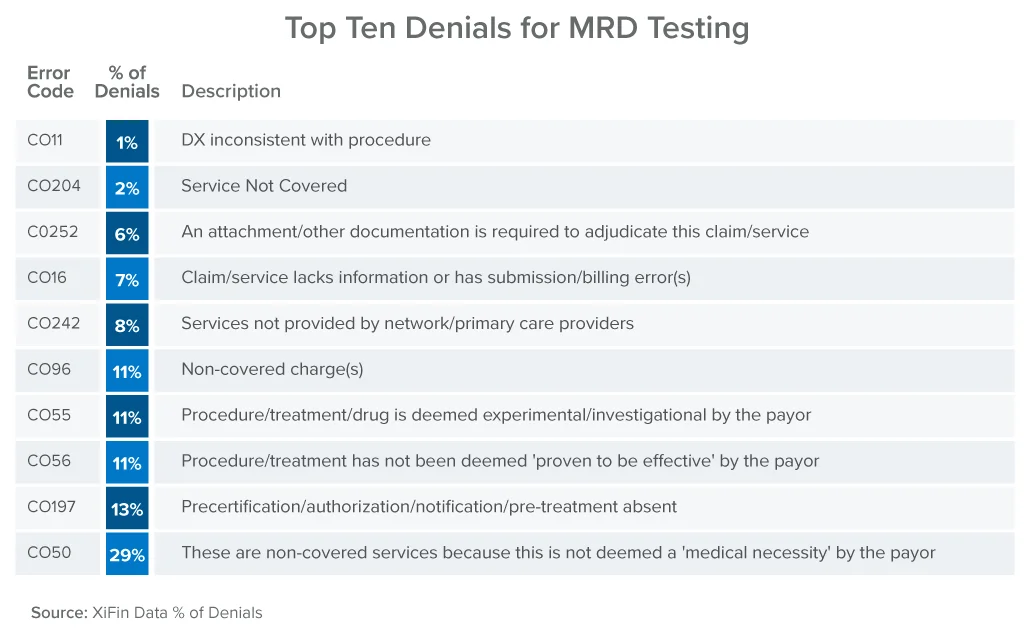
Many MRD denials are tied to documentation. Common denial drivers include:
- Medical necessity
- Non-covered services
- Missing records
- Billing errors
- Prior authorization requirements
- Investigational or experimental determinations
- Frequency limitations
- Incorrect timing relative to policy requirements
- Diagnosis-to-indication mismatch
- Missing baseline documentation
The issue is not simply whether documentation was submitted. Payors are increasingly scrutinizing whether documentation clearly supports the test’s clinical purpose, timing, methodology, and medical necessity.
Provider education is therefore a critical part of reimbursement strategy. Laboratories that build documentation expectations into intake workflows are better positioned to reduce avoidable denials.
Market Access and Revenue Cycle Need a Shared Strategy
MRD reimbursement success requires coordination across multiple functions:
- Market access teams monitor policies and engage payors
- Revenue cycle teams operationalize coding, billing, denial prevention, and appeals
- Commercial teams support provider adoption
- Finance teams track reimbursement risk, underpayments, reserves, and payment variability
When these teams work together, reimbursement data can inform payor strategy, policy requirements can shape workflows, and denial trends can guide provider education and market access discussions.
Data and analytics play a critical role in this process. High-performing laboratories use reimbursement data proactively, not just to explain past performance, but to identify emerging trends before they materially impact revenue. Monitoring denial patterns, payment variability, policy changes, prior authorization outcomes, and payor behavior can help organizations anticipate reimbursement risk, refine market access strategies, and prioritize operational improvements.
For laboratory revenue cycle management teams, this alignment turns reimbursement data into a strategic market access asset rather than a retrospective billing report.
What Laboratories Should Do Now
MRD testing has the potential to meaningfully advance precision oncology, but sustainable reimbursement requires more than clinical demand. Laboratories should treat reimbursement infrastructure as a strategic growth capability.
Key priorities include:
- Align coding decisions with payor expectations
- Engage payors early with clinical utility, evidence, and value messaging
- Plan for Z Code requirements where applicable
- Monitor coverage policies continuously
- Strengthen documentation standards and provider education
- Use denial trends and reimbursement data to inform market access strategy
- Coordinate market access, revenue cycle, commercial, finance, and operations teams around a shared reimbursement strategy
As MRD testing expands, the laboratories best positioned for growth will be those that pair clinical innovation with reimbursement readiness. XiFin Empower RCM helps laboratories operationalize payor policy strategy, documentation readiness, reimbursement intelligence, and lab revenue cycle execution to support the scalable commercialization of advanced diagnostics.
Next in the series: In Article 2, we look at the operational capabilities laboratories need to scale MRD reimbursement, including expected payment monitoring, denial analytics, configurable workflows, AI-enabled prior authorization support, and patient financial transparency.
For a deeper look at MRD reimbursement, coding, payor policy variation, and documentation readiness, watch XiFin’s on-demand webinar, “Navigating the Clinical and Financial Complexities of MRD Testing.”