- Home»
- News & Events»
- Press Releases»
- XiFin Research Quantifies Millions in Recoverable Revenue Across Ancillary Healthcare Revenue Cycles
XiFin Research Quantifies Millions in Recoverable Revenue Across Ancillary Healthcare Revenue Cycles
August 25, 2026New research with Sage Growth Partners identifies three measurable dimensions of unrealized RCM opportunity; radiology practices could recover more than $2.6 million annually through targeted improvements
Findings show that reducing preventable RCM complexity can free significant staff time and resources to be reinvested in patient care
XiFin, Inc., a leader in AI-driven revenue cycle management (RCM), today released new research conducted with Sage Growth Partners showing that growing reimbursement complexity, administrative burden, regulatory requirements, and patient financial responsibility are creating significant unrealized revenue cycle opportunity across complex healthcare service lines. Radiology practices, clinical laboratories, pathology groups, specialty pharmacies, and durable medical equipment (DME) providers may be losing recoverable revenue while dedicating substantial resources to preventable rework, manual processes, and patient financial interactions.
The No Surprises Act illustrates how these pressures are increasingly interconnected. Requirements to provide good-faith estimates to uninsured and self-pay patients extend beyond regulatory compliance. Generating and delivering those estimates adds operational complexity and can directly affect an organization’s ability to collect earned revenue. Accurate, timely, good-faith estimates help laboratories meet No Surprises Act requirements while improving price transparency, reducing patient billing friction, and supporting a more predictable financial experience.
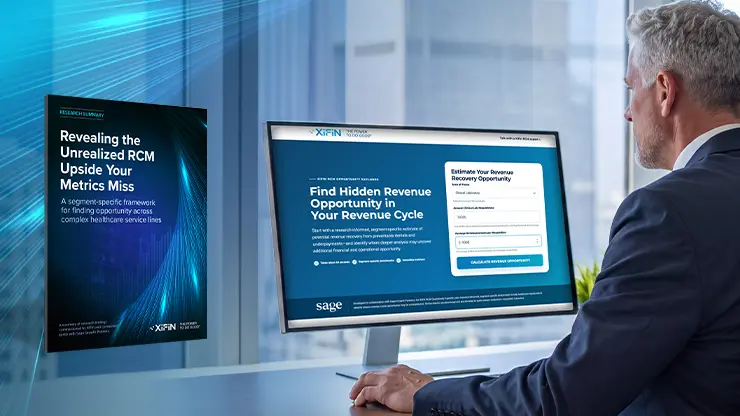
Detailed in the new research summary, Revealing the Unrealized RCM Upside Your Metrics Miss, the findings identify three interconnected dimensions of revenue cycle opportunity: Revenue Recovery, Operational Efficiency, and Patient Engagement and Access. The brief also introduces a segment-specific framework and reference benchmarks to help providers develop a directional estimate of the potential value of targeted improvements.
The findings are significant. Applied to a mid-sized pathology practice submitting 210,000 claims per year at an average value of $108 per claim, the research identifies approximately $870,000 in combined annual opportunity, including:
- $430,000 in additional revenue from reducing front-end and back-end denials and underpayments
- $110,000 in annual cost savings due to opportunities for new operational efficiencies
- $330,000 in additional revenue collected from patients with amounts due out of pocket, reducing the cost to collect on patient balances, and additional capacity to serve patients annually
For a mid-size radiology practice submitting 350,000 claims annually at a blended rate of $50 per claim, the opportunity exceeds $2.6 million with:
- $1.75 million from reducing denials and underpayments
- $677,000 from operational efficiencies
- $214,000 from patient collections with out-of-pocket due
While actual results will vary by organization, extrapolating these findings to larger practices and health systems with multiple ancillary service lines suggests that the combined annual opportunity could reach tens of millions of dollars through improvements in reimbursement performance, operational efficiency, and patient collections.
“Healthcare organizations know revenue cycle pressure is intensifying, but the more difficult task is understanding exactly where opportunity exists, how to measure it, and how to prioritize it. This research provides a practical framework for evaluating revenue recovery, operational efficiency, and patient engagement as connected drivers of financial performance,” said Sandra Greefkes, VP of Product and Partner Marketing at XiFin.
The research is based on an analysis of stakeholder interviews, industry data, and segment-specific reimbursement data to examine how financial and operational friction appears across claim denials, underpayments, preventable rework, delayed reimbursement, prior authorization burden, and patient financial responsibility confusion. It organizes these findings around three interconnected dimensions for evaluating RCM performance:
- Revenue Recovery — earned revenue at risk due to denials, underpayments, duplicate claims, late filings, and other preventable billing issues
- Operational Efficiency — administrative burden created by manual work, rework, prior authorization follow-up, documentation gathering, and appeals
- Patient Engagement and Access — financial and operational impact tied to patient financial clarity, communication timing, collection performance, and the ability to streamline the patient experience to enable providers to serve more patients
The framework is especially relevant as healthcare organizations increase investment in AI across the revenue cycle. Measuring the impact of AI-enabled workflows, analytics, and automation starts with understanding current-state baseline: where revenue is at risk, where manual work creates operational drag, and where the patient experience affects financial performance. That baseline is increasingly a compliance question as well as a financial one.
The No Surprises Act’s good-faith estimate requirements, along with a broader set of state and federal price transparency rules, have made the accuracy of patient estimates at the point of entry a measurable—and enforceable—part of the revenue cycle. Organizations that treat estimate accuracy as disconnected from denials management or patient collections often find that the same operational gaps drive all three. XiFin® Empower AI capabilities are now available to address specific revenue cycle pain points, and these modular capabilities are easier than ever to incorporate into existing RCM workflows. One example is the use of AI to increase the accuracy of patient estimates at the point of the encounter by synthesizing eligibility, pricing, deductibles, coinsurance, and co-pays that have traditionally been difficult to estimate. A second example is the appeals process, which has historically been economically challenging due to the labor required to research payer policies, gather medical-necessity and clinical documentation, and create patient- and payer-specific appeal letters and supporting packages.
Using AI to reduce research and assembly time while maintaining human oversight for escalation and submission decisions, healthcare organizations can significantly expand appeal capacity without adding staff. AI delivers meaningful productivity gains. One XiFin customer reported an 85% reduction in appeal completion and submission time and a 60% reduction in appeal-related costs.
From Research to Action: Applying AI and Benchmarking to Capture RCM Opportunity
To help providers apply the research findings, XiFin has developed the XiFin RCM Opportunity Explorer, an interactive application that uses segment-specific benchmarks to help healthcare organizations identify where they may be missing opportunities across their revenue cycle and estimate the associated value. The pathology and radiology examples above were generated using the Explorer, which produces tailored results based on claim volume, clinical specialty, and average reimbursement rate. In addition to radiology and pathology, the RCM Opportunity Explorer addresses segment-specific metrics for clinical laboratories, specialty pharmacies, and durable medical equipment (DME) providers.
The Explorer is available in two ways: an online version that allows organizations to explore results independently, and a full XiFin RCM Opportunity Assessment—a consultative engagement in which a XiFin expert applies the complete framework to the organization’s specific circumstances, workflows, and service-line mix. The Explorer will be available for use shortly after the webinar.
“Revenue cycle teams are being asked to do more with less, especially in service lines where reimbursement is complex and administrative work can build quickly. Our work with XiFin focused on helping providers identify where capturable revenue may be lost and quantify what targeted improvement efforts could be worth,” said Dan D’Orazio, CEO at Sage Growth Partners.
XiFin and Sage Growth Partners will discuss the research findings and demonstrate the XiFin RCM Opportunity Explorer during the HFMA-hosted webinar, “Pinpoint Revenue Leakage Before It Becomes Margin Loss,” on September 1. Register here (membership required)
About Sage Growth Partners
Sage Growth Partners is a healthcare growth strategy and marketing firm with deep expertise in market research, go-to-market strategy, and marketing communications. Founded in 2005, Sage combines deep healthcare industry expertise with market intelligence, strategy, and execution to help healthcare organizations solve complex market challenges and achieve sustainable growth. Sage serves clients across the healthcare ecosystem, including GE HealthCare, Press Ganey, LexisNexis, ProgenyHealth, Kyruus Health, Philips, Cecelia Health, Xealth, and XiFin, Inc. For more information, visit sage-growth.com.
About XiFin
XiFin is a healthcare information technology company that empowers organizations to navigate an evolving and increasingly complex healthcare landscape. The XiFin Empower AI RCM ecosystem and trusted data employ active intelligence and automation to reduce manual touches, coordinate workflows, accelerate customer innovation, and improve financial outcomes. Our comprehensive set of solutions spanning revenue cycle management, clinical workflow enablement, laboratory information systems, and patient engagement deliver The Power to Do Good® so that healthcare organizations can do more good for more patients. Visit www.XiFin.com, follow XiFin on LinkedIn, or subscribe to the XiFin blog to learn more.
Media Contacts
XiFin, Inc.
Ray Solone
858-436-1159
ray.solone@xifin.com
TogoRun
Peter Collins
908-499-1200
p.collins@togorun.com
Recent Press Releases
-
Oct 8, 2026
Diagnostic Lab Claim Denials Jumped 40% in 2025, New XiFin Research Report Finds
-
Sep 30, 2026
XiFin Launches Fourth Annual Pharmacy Transformation Outlook Survey as Legislative Action Moves to Reshape Pharmacist-Provided Care
-
Sep 24, 2026
Frost Radar™ Recognizes XiFin as the Only AI-enabled Ancillary Healthcare RCM Specialist Among Leading North American Providers
-
Aug 25, 2026
XiFin Research Quantifies Millions in Recoverable Revenue Across Ancillary Healthcare Revenue Cycles
-
Aug 18, 2026
XiFin Appoints Chris Martin as Chief Product Officer, Continues Building Award-Winning Leadership Team